Tuesday, January 3, 2017

Math Humor January, 2017 for all classes.

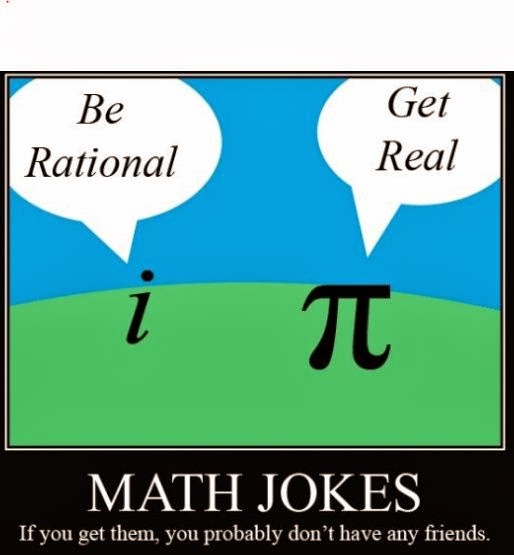
"Irrational people," says Mr Z, "hate this site." Look at the site just for kicks.  It highlights the positive integers under 30. As the site says, "Now more than ever," is this important. As I scrolled through the site, I found myself chuckling and enjoying the relationship between what we do in class and what I was seeing on the screen.

Then of course, there's more jokes within the same realm of sets of numbers:


Then, of course, there's the cute play on symbols: 


And I always need to put in a plug for why you need to take math: 

Welcome to the new year.  Find me some good math jokes; extra brownie points are given to those who find ones about the current topic. 

One point for each piece of math humor.  Go ahead, pull them from pinterest or wherever you find them.  Have fun. 


Monday, October 31, 2016

Pick's Theorem

In 1899, a man named  George Alexander Pick discovered a new and very different method of finding the area of a polygon.  This could be ANY polygon, as long as it can be placed on the Cartesian Plane and each of the vertices has coordinates that are integers.

His formula?  Let "i" be the number of lattice points (where the grid lines intersect on the coordinate plane) on the interior of the shape; let "b" be the number of boundary points (where the grid lines fall on the sides of the polygon), then Area = i + (b/2) -1.

For example, the green triangle has 4 interior points and 4 boundary points (vertices are included as boundary points).  The area is 4+(4/2)-1=5,  Another way to calculate area would help us verify this answer for area. We could verify this area found by Pick's Theorem by taking the 3x4 rectangle that completely encompasses the green triangle and subtract the three right triangle areas.
(12)  -  (1/2) 2x2 - (1/2)2x3 - (1/2)1x4 = 5. (Note: using our area estimation algorithm from class only gives an estimate, not necessarily an exact value, so don't use that method here.)

 Find the areas in TWO ways (Pick's thm and one other -- either rectifying or subtraction from a larger rectangle) shown in the previous paragraph of the remaining colored polygons.


More for practice and deeper understanding: 


Now use the illustration below to find the areas of regions A, Q and R. Verify that A = Q + R.  


Now, for your blog, find the areas outlined above using Pick's Theorem (yes, all of them) and verify them using techniques you have learned in class.  THEN, go to this website to see what happens that's interesting when you use Pick's Theorem to find areas of regions with "holes" in them.  Feel free to comment on the similarity between the proof of Pick's Theorem and how we found the areas of triangles placed on the coordinate plane in class. 

Remember your blog must be STAND ALONE. Do not require your reader to read Jammnpeaches to know what's going on in your blog. 

G. A. Pick died in a concentration camp in about 1943.  

Sources: 
http://www.cut-the-knot.org/ctk/Pick.shtml

https://en.wikipedia.org/wiki/Pick%27s_theorem

http://jwilson.coe.uga.edu/emat6680fa05/schultz/6690/pick/pick_main.htm

https://nrich.maths.org/1867

Sunday, October 9, 2016

Proving Trig Identites

You have in your possession an amazing tool called your graphing calculator.  While the TI 84 can't do algebra for you (but there are "CAS" algebra systems on calculators....just not allowed on your standardized tests), the TI 84 can help you simplify or verify identities using the graphing application of the calculator.

Let's start with those exercises where you need to "simplify" a trig statement.

The idea: if you are looking at one of those trig statements that looks crazy busy and are not sure where to go, sometimes it's easier to work through finding the answer (that is, writing the *solution*) if you know the answer. But darned it if the teachers want you to "show your work" and not just guess, so you still need to do that algebra to the trig functions.  So how can you find the answer so you can be helped to find the solution?

Let's say you are asked to simplify: (sinx+cosx)^2-2secxcscx and you don't know where to start.
Type the expression into Y1, then graph.   You'll want to be conscious of what mode you want to consider; but you'll find that the graph of this expression is simply a horizontal line at y = 1.  That information suggests to you that the expression simplifies to 1.


Now how about proving trig identities?

To review the definition of identity: An equation that is true for ALL values of the variables; not just one or two, but for all values of "x."

Perhaps you've been trying to prove an identity and have found yourself in algebra hell for a while and you're not sure if the equation is an identity after all.  How might your calculator help determine if your teacher or the text made a mistake?

This is your question to answer for your blog.  Start with the following link:
http://mathbits.com/MathBits/TISection/Trig/trigidentity.htm

In your blog, find an equation that is NOT an identity. It could be an equation with one or more solutions or it could be an equation with no solutions.   Show how your calculator would disprove the equation as an identity. Be creative. Have fun.

Then find your own identity to use. Use the basic identities or the Pythagorean identities to help you find one.  Again, be creative. Show how you would use your calculator to strongly suggest that the statement IS an identity.   Notice my change in wording...  Can't you use your calculator's graphing (or tables) tools to prove that an equation is an identity?  You'll need to address that also.

In sum:
a. Find an equation that is not an identity.  Use your calculator to demonstrate that it's not an identity. Be creative. Take screen shots, pictures, images, etc.
b. Find an identity.  Use your calculator to show what an identity looks like on the screen. Be creative. Take screen shots, pictures, images,etc.
c. Why can you not prove an identity using the graphing or tables tools? Explain.
Fourth Dimension

In class, we began a brief conversation about the tesseract or the hypercube.  It's amazing how simple transformations can create such a powerful concept.  In this blog, you have an opportunity to think about this more deeply or see some beautiful images.

Here are a couple links for fourth dimension discussion:

High School Student Discussion. (This is an academic discussion by a bright high school student, dry in imagry, but with some great ideas.

Forget about your familiar world. (This could simply blow your mind with the simplex, It's 14 minutes that just keeps getting more and more interesting. Watch the first 8 minutes then I challenge you to just try to stop the video. At 9 minutes you have the hypercube. )

And here's someone's story of building a visual or a double-rotation of a tesseract. It has a great set of visuals.

For those of you who say, "Hey, this could be a process for finding more than the 4th dimension..."  Here's an image:

To blow your 1-dimensional mind further: here's a 2-dimensional image of a 4-dimensional shape represented in 3-dimensions casting a 2-dimensional shadow.


OR, find your own resource for thinking about a tesseract or hypercube or the 4th dimension (Please, no Dr. Who links....keep this mathematical.)

I hope this is fun for you; please keep asking yourself the "Why?" or "How?" questions so you can delve a little more deeply into your blog.  Find something fun or interesting and write about it.  Let is be recreational!


Geo/Algebra II,Due 10/20/2016: Fourth Dimension

In class, we began a brief conversation about the tesseract or the hypercube.  It's amazing how simple transformations can create such a powerful concept.  In this blog, you have an opportunity to think about this more deeply or see some beautiful images.

Here are a couple links for fourth dimension discussion:

High School Student Discussion. (This is an academic discussion by a bright high school student, dry in imagry, but with some great ideas.

Forget about your familiar world. (This could simply blow your mind with the simplex, It's 14 minutes that just keeps getting more and more interesting. Watch the first 8 minutes then I challenge you to just try to stop the video. At 9 minutes you have the hypercube. )

OR, find your own resource for thinking about a tesseract or hypercube or the 4th dimension (Please, no Dr. Who links....keep this mathematical.)

I hope this is fun for you; please keep asking yourself the "Why?" or "How?" questions so you can delve a little more deeply into your blog.  Find something fun or interesting and write about it.  Let is be recreational!

Friday, September 16, 2016

Without Trig, your House Would be Lopsided.

This blog post follows the "Grade of the Road" post; you'll want to read that one first.  Some of you have commented on this blog last year already (hopefully, you will remember that blog.) If you have not, take a minute to evaluate what trig function (using the angle of elevation) is the slope (or grade) of the road.  Professionals who work on roads use the word "grade" to refer to the steepness of the slope of a road.

Professionals constructing roofs use the word "pitch" instead of "grade."  Clearly to understand grade, pitch, and their relationship to each other, one must have more than a simple understanding of the basic trigonometric function called "tangent" and the algebraic concept of "slope" that you've learned in previous classes.

The pitch of a roof is described the following way. If a plan calls for a 11/18 pitch roof, then the roof rises 11 inches for every 18 inches of horizontal.  (Horizontal is "run" in the image shown.)


Find the angle of elevation in the 11/18 pitch.  Then discuss the relationship between "pitch," "grade" of a road and "slope."  Furthermore, what does "tangent" have to do with "pitch," "grade" and "slope"?

Then find the full length of the total rise and the "rafter line" (refer to the illustration above) if the full length of the "run" of the rafter is 22 feet.  You'll need to think about similar triangles.

Your blog needs to (a) stand alone, that is, not require your reader to read JammnPeaches. (b) be written in complete sentences  (c) complete the math with explanations in English.

There's more cool math and geometry in these constructions, particularly when there's gables or two different pitches involved in a single house.  If you'd like to explore this OYO or in a blog post, feel free to do so. The reference below is excellent for this blog and for your future studies.  If you have Geometer's Sketchpad, then you can see the sketchpad illustration of the "valley" between two roofs of different pitches.

reference:
http://jwilson.coe.uga.edu/EMAT6680Su09/King/Roofing/Application%20of%20%20Mathematics%20in%20Construction.htm

Grade of a Road.

Driving East on I-70 into Denver, there's signs posted about the road being a "6% grade."  What's that mean?  Why is this posted on the highway?   A 9% grade is steeper.  Rock climbers think nothing of a 100% grade; many even climb an infinite grade.  mmm.  What's that mean? We've explored this briefly in class, in particular in regard to the Pike's Peak Cog Railway that sports a 25% grade in one section.

Do a short quick google search on "Grade of Road" or "Incline."


I've never seen or driven on an 18% grade or a 25% grade on a road; the 9% grade I drove on was steep enough.  What grades have you seen? I think there's a 12% grade into Jackson Hole, Wyoming.  Anyone drive on that grade?


Your blog: How is the grade of a road established? What's it mean to have an x% grade?  Explain.  Is this helpful information?

The grade of a road has EVERYTHING to do with the slope of a line.  What is the slope of a line?  How is this related?

Here's an image to help in your description:

In your blog, to earn full credit, you will need the following: (a) to connect trigonometry, slope, and grade together; (b) to include an application -- maybe something you saw on a road or read about.  You  may NOT write about the Manitou (Pike's Peak) Incline (that was already done in class); (c) to write complete ideas in full sentences. Your blog needs to stand alone -- that is, not require your reader to also read my blog. 

Images are great, but this is a blog with an implication that there's an essay there.  If you have any questions, please ask!